the wigglybus
| home |
| mission |
| projects |
| publications |
| clients |
| drtbus |
| contact |
The Wigglybus website
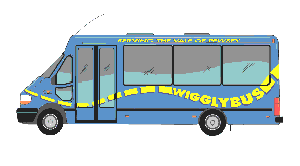
click here or on the bus to go to the wigglybus website!
MTRU and the Mere Wigglybus
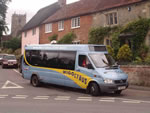
The Mere Wigglybus
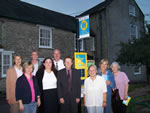
Attendees at the WSEP launch gather by the Mere Wigglypost
SOCIAL ENTERPRISE
Starting with MTRU's work for the Countryside Commission in Wiltshire in 1995, a series of ideas were developed to improve rural transport. These included replacing the concept of public transport as a "safety net" for the less well off with a network which would attract people out of cars. This needed the right policy, charging and funding framework but also needed some new ideas for the type of service which would be popular.
MTRU developed the Wigglybus concept independently but there were parallel developments in other parts of Europe, some of which were included in the European SAMPO (later SAMPLUS and FAMS) projects.
The Wigglybus remains a much quoted good practice example and was one of the first to be funded through the UK Government's Rural Bus Challenge. It won the Bus in the Countryside Award in 2000. The website which we developed had basic information on the services, news and research findings.
MTRU project managed and implemented the Wigglybus project in the first instance, and subsequently was appointed as adviser for the expansion of the service into two new areas. We continued to be members of the original management group. In 2005 this was wound up and the County Council took over.
In 2006, MTRU worked with local community groups in Wiltshire to form the Wigglybus Social Enterprise Partnership (WSEP) - a non-profitmaking Community Interest Company (CIC). This put in a bid to run one of the three Wigglybus areas in Mere and was successful - taking over operation in September 2006. The CIC bid in 2007 for the other Wigglybus services was, however, not successful. MTRU is happy that it was one of the original partners and is continuing to provide support.
One interesting aspect of this approach is that the company has sought to work with local community transport to co-ordinate both operations and marketing. Elsewhere in the UK, several community transport operators have moved on to bid for and to run public bus services. The WSEP started by running a public service and sought to use its community roots to act as the focus for voluntary and semi-voluntary schemes, as well as organising one off excursions. This revived one of the original intentions of the 1999 Wigglybus project which was never fully developed.
The WSEP did, however, run into significant difficulties in bidding for local government funded services. This was at least in part due to the perceived conflict between helping a local community group and continuing with traditional tendering. Such problems led to the company deciding to suspend activities at the present time and would have to be properly resolved if the third sector is to play its full part.